
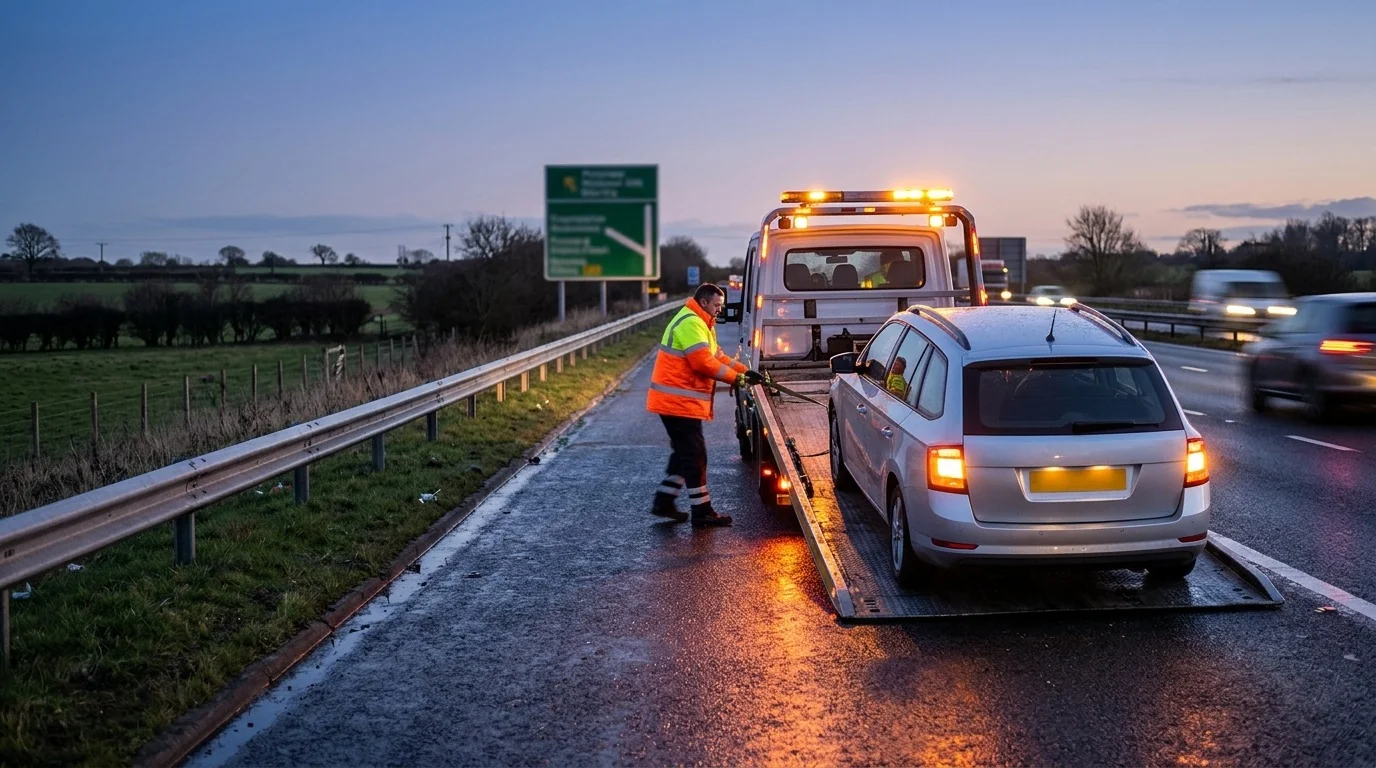
Few things spoil a journey like the moment your dashboard lights up, the engine cuts out or you hear the thump of a flat-tyre. Whether you are on a quiet street in Leicester or in the middle lane of the M1, knowing how roadside assistance works can save you money, time and a lot of stress.
This guide explains what roadside assistance is, what it normally covers in the UK, what affects the cost of vehicle recovery, and exactly what to do if you break down on a motorway. It also shows how to choose a provider you can trust.
Roadside assistance is an emergency service that sends a trained technician or recovery vehicle to you when your vehicle breaks down. It aims to fix minor faults at the scene, or, if that is not possible, to move your vehicle safely to a garage, your home or another agreed address.
You may see the terms roadside assistance, breakdown cover and vehicle recovery used as if they mean the same thing. They are related but not identical:
What is included depends on the provider and the level of cover you choose, but most roadside assistance help falls into the following areas:
Cover levels are usually described in four steps: roadside (help at the scene), recovery (transport if it cannot be fixed), home start (help if you break down at or near your home) and onward travel (alternative transport or accommodation). Extras such as European cover are normally sold separately.
If your vehicle is in a dangerous position, such as stopped in a live lane, call 999 first. In other situations, these are the moments when emergency roadside assistance or emergency car recovery is the right call:
A good rule of thumb: if you are unsure whether it is safe to carry on driving, it is not. Pull over safely and call for help rather than risking further damage or an accident.
There is no single fixed price for vehicle recovery in the UK. The cost depends on how far the vehicle has to travel, what type of vehicle it is, the time of day and where you have broken down, so recovery companies normally give a quote based on your situation.
Because every breakdown is different, a fair price for a car stuck in a Leicester side street will not be the same as a 7.5-tonne lorry stranded on the M69. That is why honest recovery companies quote the job rather than quoting one price for everyone. Midlands Recoveries does not publish a fixed price list, and instead gives a quote once it knows what you need.
In most cases, yes. A roadside assistance provider can usually attend a flat tyre and fit your spare wheel if you have a usable one. If you only have a sealant kit, the wheel is badly damaged or there is no spare, the vehicle can be recovered to a tyre fitter or garage.
The flat tyre is one of the most common reasons drivers search for help, and it is also one of the most misunderstood. Three points are worth knowing before you need them:
A motorway breakdown is one of the most dangerous situations a driver can face, so it pays to know the steps in advance. The guidance below follows advice from National Highways.
Midlands Recoveries provides motorway breakdown recovery on the M1 and M69, covering M1 Junctions 20 to 23 and the full M69, along with the surrounding Leicester, Loughborough and Coalville areas. The company is available 24/7 and aims to reach you within 30 minutes of your call.
Not every recovery company suits every situation. Before you commit to a membership or call someone on the day, check these points:
Midlands Recovery & Rescue is a locally based breakdown and vehicle recovery company serving Leicester and the wider Midlands. Its services include:
The company covers an area within 21 miles of its Leicester base, including Leicester, Loughborough, Coalville, Hinckley, Nuneaton, Melton Mowbray, Oakham, Corby, Earl Shilton and the East Midlands airports. If your vehicle earns you a living, fast commercial recovery can keep downtime to a minimum.
Roadside assistance means a technician tries to get you moving again at the scene, for example with a jump start or a wheel change. Vehicle recovery means your vehicle is transported on a recovery truck to a garage, home or another address when it cannot be fixed at the roadside. Many providers offer both in one call-out.
The cost of emergency car recovery in the UK depends on the distance, the type of vehicle, the time of day and your location, so there is no single fixed price. Reputable companies give a quote based on your situation. Ask for the total cost before the vehicle is dispatched, and check whether mileage is included.
Yes, in most cases. A roadside assistance provider can usually fit your spare wheel if you have a usable one. If you only have a sealant kit, the wheel is badly damaged or there is no spare, the vehicle can be recovered to a tyre fitter or garage. The cost of a replacement tyre is normally separate.
Move left, ideally onto the hard shoulder or an emergency area, and switch on your hazard lights. If you can get out safely, leave through the left-hand doors, stand well away from traffic and call National Highways on 0300 123 5000, then your recovery provider. If you cannot get out, keep your seatbelt on and call 999.
Yes. You do not need a membership to call a recovery company. Pay-on-the-day call-outs are offered by many independent operators, although they usually cost more than a call-out covered by an annual policy. Give your location, vehicle details and destination, and ask for a quote before agreeing to the job.
Roadside assistance is less about the breakdown itself and more about what happens next: how fast help arrives, how safely your vehicle is moved and how clearly the cost is explained. Knowing your cover, keeping the right phone numbers to hand and acting calmly will make any breakdown easier to manage.
If you break down in Leicester, Loughborough, Coalville or on the M1 or M69, Midlands Recoveries is available 24/7. Call [0116 429 3528], email info@midlandsrecoveries.co.uk or request a callback.